
Published on March 23, 2026 | 3 min read
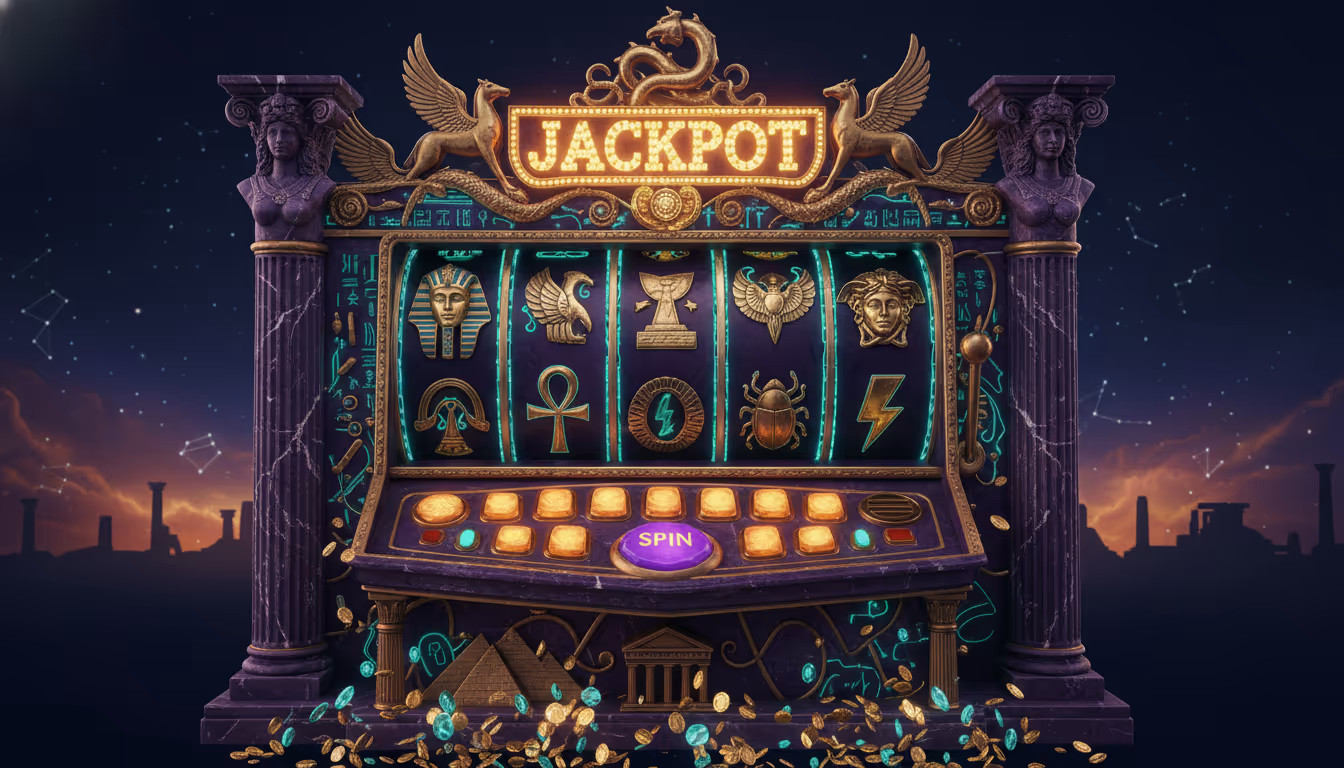
Mythology is the most crowded theme in slot design, and the reason is practical rather than poetic: the material is in the public domain, the characters arrive with conflict and hierarchy already attached, and a pantheon gives a designer a natural excuse for a quest structure with stages and escalating rewards.
Which legends the reels borrow from has shifted over the past decade, and the mechanics bolted onto them have changed more than the themes have.
Which legends the reels actually use
Three traditions dominate. Egyptian mythology arrived first and never left — the Book of Ra lineage and its many descendants built an entire sub-genre on expanding symbols and a single retriggering free-spin round. Norse mythology took over in the 2010s, with Thor and Odin appearing on more reels than any other figures. Greek mythology is the current centre of gravity, and Zeus in particular has become a shorthand for the multiplier-driven tumbling grid.
The interesting design sits in the rarer pantheons, because a crowded shelf rewards distinctiveness: Celtic, Slavic, Mesoamerican, Japanese and Polynesian traditions turn up in smaller studios’ catalogues, usually with mechanics borrowed from the big three but iconography that has not been worn smooth.
What a theme never does is change the game. The artwork sits on top of a mathematical model — reel strips, paytable, hit frequency and a certified return — and that model is indifferent to whether the high-paying symbol is a thunderbolt or a scarab. How a slot is built sets out why the two layers are separate.
- Egyptian — expanding symbols, single retriggering free-spin round.
- Norse — picking rounds, stacked wilds, multi-level free spins.
- Greek — tumbling or cascading grids with running multipliers.
- Rarer pantheons — same mechanics, less familiar iconography.
What the jackpot mechanics behind them do
Mythology titles are a favourite home for jackpots because a pantheon makes a tiered prize feel natural, and the tiers are where the arithmetic hides. A fixed jackpot is a top prize expressed as a multiple of the stake and funded out of the normal return. A progressive is funded by taking a slice of every stake into a shared pool, which is why the base return of a progressive slot is lower than that of a flat-pay game: the money in the counter came out of the payout percentage.
Pools come in two shapes. A local pool is fed by one casino, grows slowly and pays relatively often. A networked pool is fed by every casino running the title, which is how a single game accumulates prizes no operator could fund alone. Either way, one spin wins it, and the odds of that spin are not improved by the size of the counter.
A quest structure — collect symbols, unlock a stage, reach the final round — is presentation rather than mathematics: the collection meter is stored against your account and the rules are identical for every player. The same instinct that makes an unfinished quest hard to walk away from is the one what AI and VR actually change is built on, the same one behind the superstitions players attach to lucky games, and the cost of each spin remains what the house-edge arithmetic says it is.
| Jackpot type | How it is funded | Effect on base return |
|---|---|---|
| Fixed top prize | Out of the normal payout percentage | None |
| Local progressive | A slice of stakes at one casino | Lower |
| Networked progressive | A slice of stakes across many casinos | Lower still |
| Must-hit-by pool | As above, with a stated ceiling | Lower, and public |